

Manual Scheduling vs. Software for Sports Officials
Managing sports officials can be time-consuming and error-prone, especially with manual methods like spreadsheets and texts. Software solutions simplify this process, saving time and reducing mistakes.
Here’s what you need to know:
- Manual Scheduling: Uses tools like spreadsheets, emails, and phone calls. It’s cost-effective but prone to errors, time-consuming, and struggles with growth.
- Software Scheduling: Platforms like YesRef automate tasks such as availability tracking, conflict detection, and payments. These tools save time, improve accuracy, and handle larger operations with ease.
Quick Comparison
| Feature | Manual Scheduling | Software Scheduling (e.g., YesRef) |
|---|---|---|
| Time Required | High | Low (tasks automated) |
| Error Risk | High (double-bookings, conflicts) | Low (real-time updates, conflict checks) |
| Availability Tracking | Manual | Automated, real-time updates |
| Communication | Scattered (emails, texts) | Centralised, instant notifications |
| Scalability | Limited (hard to grow) | Handles large volumes, multiple sports |
| Payment Management | Manual, error-prone | Automated, secure, fast |
When to Choose Manual Scheduling: Ideal for small organisations with simple schedules and fewer than 50 games a month.
When to Choose Software: Best for larger leagues, multiple sports, or frequent changes. Software saves time and reduces errors, making it a practical choice as operations grow.
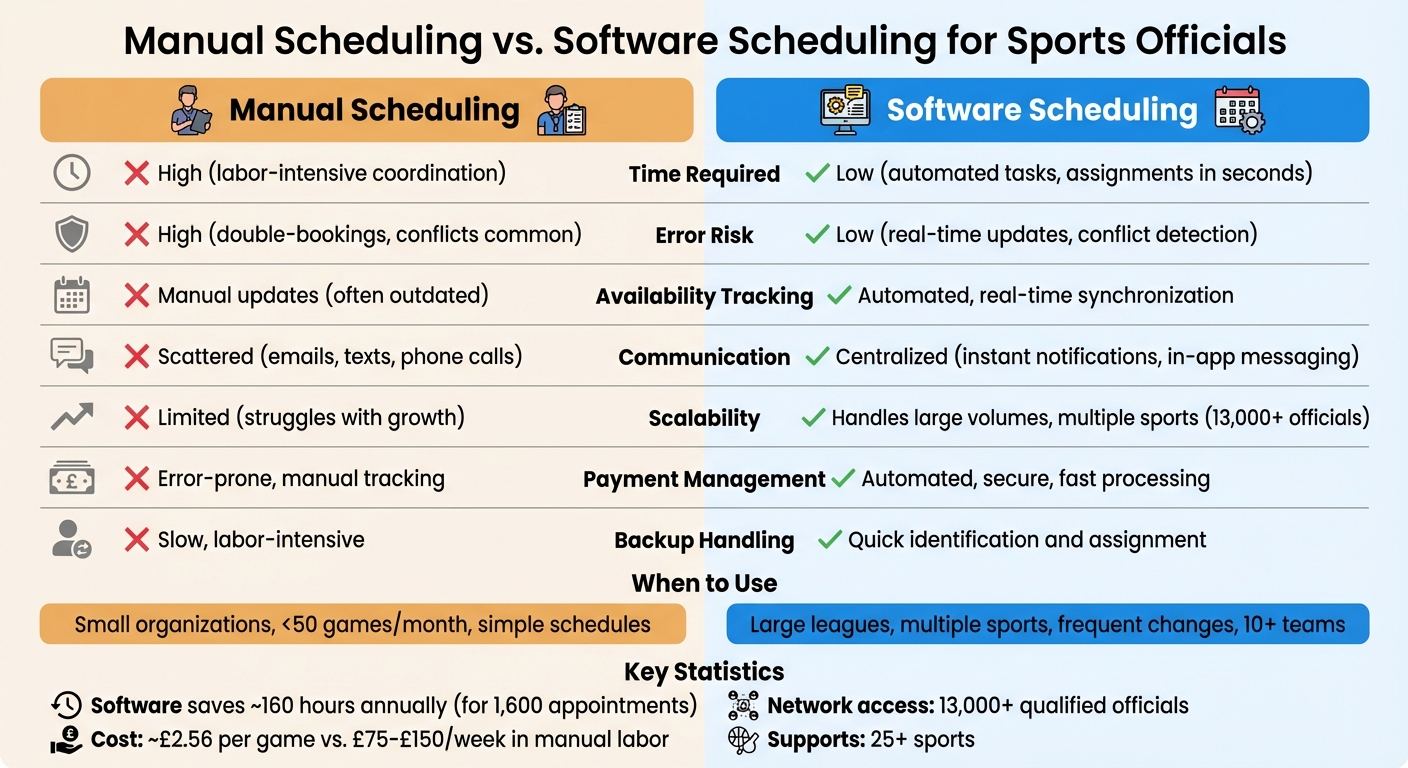
Manual vs Software Scheduling for Sports Officials: Feature Comparison
What Is Manual Scheduling for Sports Officials?
Manual scheduling relies on tools like spreadsheets, emails, texts, phone calls, and even physical notes to coordinate sports officials. Schedulers manage game schedules, keep track of contact details, and assign officials using these platforms. When a match needs coverage, they send offers via email or text, and officials respond with their acceptance or decline. Availability is tracked separately, often through scattered messages or notes, forcing assignors to piece together information from multiple sources.
This method is often used by smaller organisations or those working with tight budgets, as it avoids the cost of software, subscriptions, or training. For grassroots clubs or local leagues with predictable schedules, manual processes might suffice. While cost-saving, this traditional approach comes with notable challenges when weighed against its benefits.
The fragmented nature of manual scheduling makes it hard to maintain a clear overview, increasing the chances of double bookings and errors. Assignors must manually verify game times and officials’ availability to avoid mistakes like overlapping assignments. Payment tracking through spreadsheets can lead to delays and inaccuracies, and storing sensitive information in emails or spreadsheets raises security concerns.
Benefits of Manual Scheduling
The primary advantage of manual scheduling is the absence of upfront costs. It uses tools and devices that organisations already have, eliminating subscription fees or additional expenses. Additionally, manual systems allow for direct communication with officials, which can add a personal touch and provide context that automated systems might miss. For smaller organisations with limited events, this hands-on approach can feel manageable.
Drawbacks of Manual Scheduling
As the number of fixtures grows, manual scheduling quickly becomes a time drain. Assignors often spend hours matching officials to games, making phone calls, and re-confirming assignments – earning it the nickname "administrative quicksand". Last-minute cancellations exacerbate issues, requiring urgent communication that can lead to further scheduling errors and even no-shows. Human error is another significant risk, with double bookings, conflicts, and assigning unqualified officials being common problems. During busy periods, tracking constantly changing availability becomes overwhelming. On top of that, manually handling payroll and tax forms adds another layer of administrative burden .
While manual scheduling may seem cost-free on the surface, the labour-intensive nature of the process results in ongoing inefficiencies. These challenges highlight the appeal of digital solutions, which will be addressed in the next section.
sbb-itb-9e12d6d
What Is Software Scheduling for Sports Officials?
Software scheduling replaces outdated tools with a streamlined digital platform that automates the process of assigning officials to games. With this system, assignors can rely on a single, centralised platform where officials update their availability in real time. The software filters eligible candidates, flags scheduling issues like double-bookings, and sends instant notifications when assignments are confirmed. These core features – automated updates, conflict detection, and instant alerts – are at the heart of what makes these platforms effective.
Beyond scheduling, modern platforms improve financial and communication workflows. For instance, tools like YesRef simplify everything from game assignments to secure digital payments. Officials can manage their schedules, accept assignments, and receive updates through mobile apps or web portals. In cases of last-minute cancellations, the system provides immediate visibility and tools to quickly find replacements.
By automating these tasks, the software significantly reduces the administrative workload. YesRef, for example, has handled over £5,000,000 in fees for 150,000 games across 350+ sports organisations. Supporting over 25 sports, including football, basketball, netball, rugby, and cricket, it caters to a wide range of groups – from grassroots clubs to national governing bodies.
Main Features of Software Scheduling
Modern scheduling platforms centralise tasks that would otherwise require multiple tools and manual effort. For example:
- Automated availability tracking ensures assignors only see officials who are free and meet the necessary qualifications.
- Conflict detection highlights overlapping games or missing certifications before assignments are finalised.
- Digital payment systems enable secure, near-instant transactions and generate detailed financial reports, removing the need for manual bank transfers and scattered spreadsheets.
Platforms like YesRef also support multiple sports, managing over 25 different disciplines. Their #LiveGamesList feature operates 24/7, allowing sports providers to post games so officials can quickly find and fill local opportunities. Mobile accessibility ensures officials can update their availability and receive notifications on the go.
These features not only simplify scheduling but also deliver practical, real-world benefits.
Benefits of Software Scheduling
One of the biggest advantages is the time saved. Organisations using platforms like YesRef can save around 160 hours of administrative work annually when managing 1,600 appointments – a significant efficiency gain, considering tasks previously took six minutes per appointment.
Scalability is another benefit. YesRef connects organisations with over 13,000 qualified officials, offering access to a much larger pool than traditional methods.
The software also improves accuracy. Automated conflict detection prevents double-bookings and ensures only qualified officials are assigned. Real-time notifications reduce no-shows and minimise the need for follow-ups, while automated payment systems eliminate delays tied to manual invoicing. At roughly £2.56 per game (based on an annual cost of £2,050 for 1,600 appointments), the cost of the software is easily offset by the time saved and the reduction in errors.
Manual Scheduling vs. Software: Side-by-Side Comparison
Let’s break down the differences between manual scheduling and software solutions to see how they stack up against each other.
Manual scheduling depends on a mix of separate tools that need constant updates. On the flip side, software platforms bring everything together in one place – tracking availability, spotting conflicts, managing communication, and even handling payments – all updated in real time.
When it comes to time, the gap is huge. Manual methods demand a lot of coordination, while software can assign tasks in seconds.
Errors are another big difference. Double-bookings and missed cancellations are common with manual scheduling. But automated software reduces these risks by checking for conflicts and keeping availability updated in real time, ensuring only qualified and available officials are assigned.
Scalability is where manual scheduling really struggles. As the number of games grows, it becomes harder to manage. In contrast, software handles large volumes effortlessly. For example, YesRef supports over 25 sports and connects with a network of more than 13,000 officials.
Here’s a detailed comparison to make things even clearer:
Comparison Table
| Metric | Manual Scheduling | Software Solutions (YesRef) |
|---|---|---|
| Time Required | Involves significant manual coordination | Assignments completed in seconds through automation |
| Error Risk | High – prone to double-bookings and missed cancellations | Low – conflict-checking and real-time updates ensure accuracy |
| Availability Tracking | Relies on manual updates, which can become outdated | Real-time updates keep information synchronised instantly |
| Communication | Scattered across emails and texts | Centralised with automated notifications and in-app messaging |
| Scalability | Struggles to manage growth as leagues expand | Handles large volumes and multi-sport operations seamlessly (13,000+ officials) |
| Payment Management | Prone to errors and delays due to manual tracking | Streamlined with automated reporting and payment processes |
| Backup Handling | Finding replacements is slow and labour-intensive | Quickly identifies and assigns available backup officials |
This comparison highlights just how much more efficient and reliable software solutions can be.
How to Choose Between Manual Scheduling and Software
Deciding between manual scheduling and software solutions depends on your organisation’s immediate needs and long-term goals. The sports software market, for instance, is projected to hit around £8.5 billion (US$10.84 billion) by 2025, growing at an annual rate of approximately 11% . But not every organisation needs to make the switch right away.
A simple way to evaluate your options is by comparing costs. For example, if an administrator spends five hours a week on scheduling at a rate of £15–£30 per hour, the weekly labour cost adds up to £75–£150. In contrast, cloud-based sports management software typically costs between £20 and £200 per month. This comparison can help determine which option aligns better with your organisation’s scale and budget.
When Manual Scheduling Works
Manual scheduling can be effective for smaller operations with straightforward needs. If you’re running a single-venue organisation with predictable schedules or managing fewer than 50 games a month, spreadsheets and phone calls might do the job. This approach also works well for one-off tournaments or teams with consistent officials. In such cases, the time and effort required to set up a software platform, train staff, and migrate data may not be worth it. Stick with manual methods until the inefficiencies start to outweigh the benefits.
When Software Becomes a Necessity
Software solutions are a game-changer when you’re dealing with a high volume of fixtures, multiple sports, or frequent last-minute changes. If you’re managing dozens – or even hundreds – of games weekly, software can simplify your workload and reduce errors.
Take YesRef as an example. It offers flexible pricing, starting at £7 per official for ad hoc games and £25 per month for regular scheduling, with enterprise options for larger organisations. Beyond automating scheduling tasks, YesRef connects you to a network of over 13,000 officials across 30+ sports, ensuring you have access to qualified personnel as your organisation expands.
Conclusion
Selecting between manual scheduling and software depends on factors like the size of your organisation, the complexity of your schedules, and your need for efficiency. For smaller organisations with straightforward and predictable schedules, manual methods might still work. But as soon as your operation grows to include more than 10–12 teams or multiple venues, manual processes can quickly become overwhelming and impractical.
Scheduling software consolidates tasks that are often scattered across different tools. It handles assignments, tracks availability, streamlines communication, and even manages payments. This results in fewer errors, quicker workflows, and an improved experience for both assignors and officials. Features like automated conflict checking reduce double-bookings, real-time availability updates cut down on unnecessary back-and-forth, and integrated payment systems simplify administration.
The industry is clearly moving towards digital solutions. By 2032, the sports league software market is expected to grow to around £777 million (US$989 million), reflecting a global trend towards platforms that not only simplify operations but also improve retention and reduce stress.
In light of these trends, modernisation isn’t just a convenience – it’s becoming essential. For organisations looking to take that step, YesRef offers a practical and affordable solution. With prices starting at £7 per official for one-off games and a £25 monthly plan for regular scheduling, YesRef connects you to a network of over 13,000 sports officials across 25+ sports. It automates time-consuming tasks, making it easier to manage everything from local matches to large-scale competitions. The right software can transform scheduling into a smooth and efficient process.
FAQs
What’s the quickest way to tell if manual scheduling is still working for us?
Manual scheduling can be a mixed bag. To see if it’s still working for you, ask yourself: does it save time and avoid mistakes? If you’re dealing with headaches like double bookings, missed appointments, or endless back-and-forth communication, it might be time for a change. On the other hand, if everything runs smoothly, with minimal errors and hassle, your current system could still be doing the job. But if not, switching to scheduling software like YesRef could help you improve precision, save time, and make everything run more efficiently.
How hard is it to move from spreadsheets to scheduling software?
Switching from spreadsheets to scheduling software, like YesRef, is usually a smooth process. While there’s a bit of a learning curve at the start and some work involved in transferring data, this change simplifies everything. It automates tasks like scheduling, organising, and handling payments. For many organisations, the payoff is clear: better efficiency, fewer mistakes, and improved communication make the initial effort more than worthwhile.
What security and payment controls should scheduling software include?
When it comes to scheduling software for sports officials, security and payment processing are non-negotiable priorities. Here’s what to look for:
- Access Management: Tools like facility entry codes can help control who gets access, reducing the risk of unauthorised entry.
- Secure Payment Processing: Digital transactions should always be encrypted to safeguard sensitive financial data.
- Automated Reminders and Digital Waivers: These features not only streamline operations but also reduce the need for manual handling of personal or sensitive information, adding an extra layer of security.
The right software should combine these elements to ensure both safety and efficiency in managing sports operations.